
At Leadtech we use Artificial Intelligence (AI), Machine Learning (ML) and technologies based on Python in order to assist organisations in turning large amounts of raw data into useful business intelligence and at the same time automate repetitive and time-consuming processes. The data analytics and automation solutions which are powered by AI allow businesses to enhance their operational efficiency, decrease the need for manual work, detect hidden patterns and make quicker, data-driven decisions.
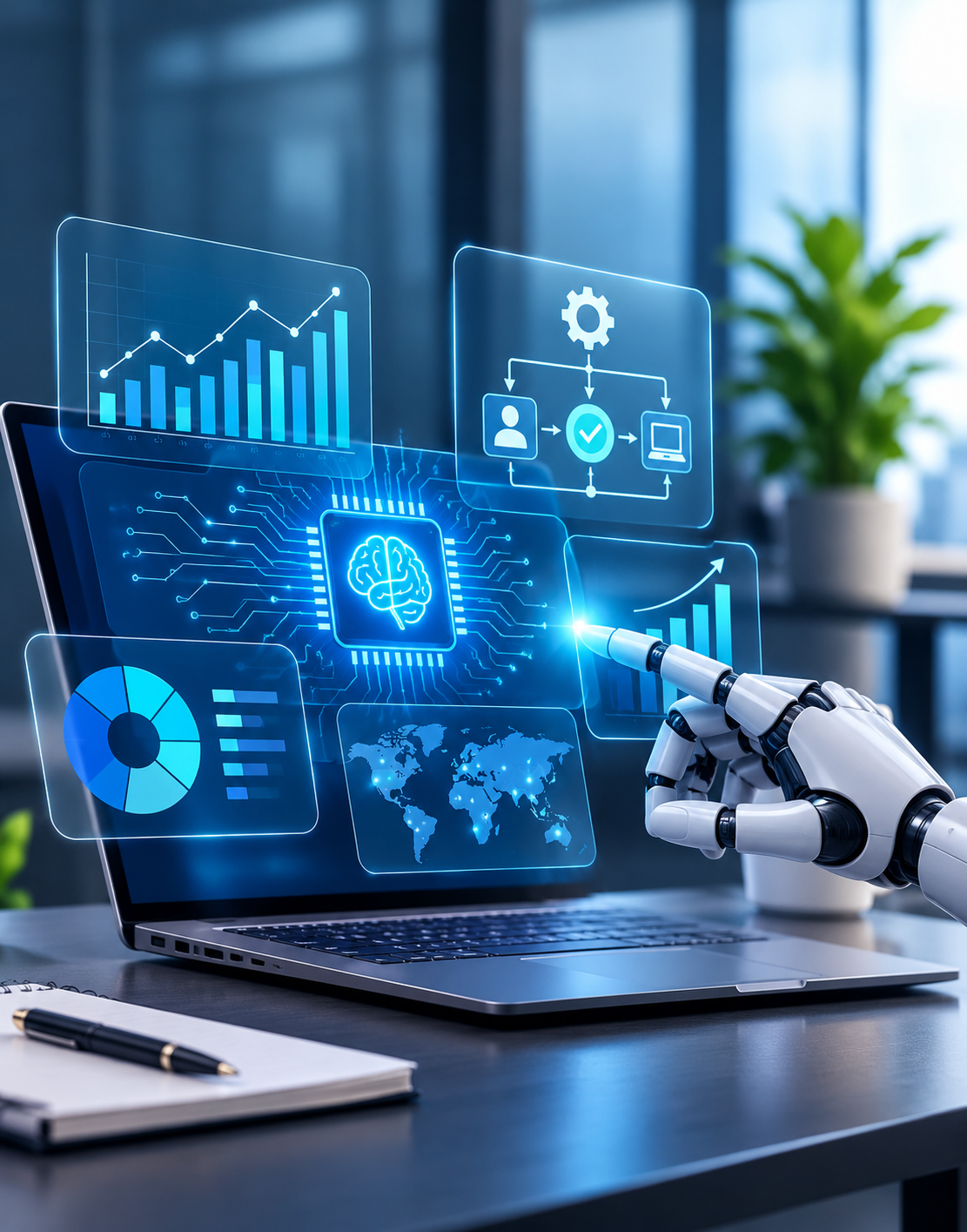
From automated data collection and validation to predictive analytics, intelligent reporting and workflow automation, we develop customised solutions that integrate with existing business applications, databases and enterprise systems. The method involves the use of data engineering, statistical analysis, machine learning and generative AI in order to develop intelligent software that deals with real-world business challenges.
Software Development Services
It is important to select the right software development partner if you want to create technology that provides ongoing business value. The way we proceed is to mix our technical expertise with a solid understanding of business processes and operational objectives.
Tailor-made solutions: software that is designed according to your particular business needs and processes.
The technology stack currently in use is Python, Next.js, MySQL, and Microsoft SQL Server.
Scalable Architecture
Applications are designed so as to be able to deal with future growth and the addition of new features.
Development with a Focus on Business
The creation of digital solutions aimed at increasing productivity and operational efficiency.
Applications Based on a Database
It provides reliable data management, include structured storage, and have reporting capabilities.
Engineering with a Focus on Security
Using suitable methods for authentication, access controls, and data protection.
Full Development Support
Help with planning, design, development, testing, deployment, and maintenance.
Flexible Deployment
Implementation options based on your technical infrastructure and business needs.
1. AI-Powered Data Analytics Services
Modern organisations obtain data from surveys, from customer interactions, from transactions, from field operations, from websites, from enterprise applications and from other digital systems. It is time-consuming to analyse this data by manual methods and this may prevent the identification of important trends. Our analytics solutions, which are powered by AI, enable organisations to process large datasets, identify significant patterns and produce insights that aid strategic planning and operational decision-making.
- Automated Data Collection and Integration
We develop systems that collect and consolidate data from multiple sources, including Excel files, CSV files, SQL databases, APIs, web applications, survey platforms and enterprise systems.
Using Python-based data pipelines, we automate the extraction, transformation and loading of data into centralised databases or analytical platforms. This reduces manual data entry and makes information available for reporting and analysis.We develop systems that collect and consolidate data from multiple sources, including Excel files, CSV files, SQL databases, APIs, web applications, survey platforms and enterprise systems.
- AI-Based Data Cleaning and Validation
Bad data quality can have an impact on the accuracy of reports and business decisions. In order to deal with common data quality problems, we have developed intelligent systems for processing data.
Our solutions can help with:
– Identifying duplicate records and incomplete entries.
– Detecting inconsistent formats and invalid values.
– Standardising names, addresses, categories and other fields.
– Identifying unusual values and potential data-entry errors.
– Matching similar records across multiple databases.
– Flagging suspicious or inconsistent responses for human review.
– Generating data-quality reports and exception lists.
Libraries written in Python such as Pandas and NumPy are suitable for processing structured data, whereas those used for machine learning and natural language processing can help with more complicated tasks such as classification, matching and anomaly detection.
Predictive Analytics and Forecasting
We develop machine learning models that use historical data to estimate future outcomes, identify potential risks and support better resource allocation.
Applications include:
– Sales and revenue forecasting.
– Demand and inventory prediction.
– Customer behaviour and churn analysis.
– Workforce and resource planning.
– Asset failure and maintenance prediction.
– Identification of operational bottlenecks.
– Risk scoring and anomaly detection.
Before they are used in making operational decisions, models are assessed using appropriate historical baselines and business-specific performance metrics.
AI – Driven Business Intelligence and Dashboards
We combine AI analytics with interactive dashboards to help management teams understand performance indicators, identify trends and monitor operations.
Our solutions can provide:
– Real-time or scheduled KPI dashboards.
– Automated daily, weekly and monthly reports.
– Trend and comparative analysis.
– Exception alerts and threshold-based notifications.
– Drill-down reporting by location, department, category or time period.
– Natural-language queries for approved business data.
– AI-generated summaries of key findings and performance changes.
For instance, a management user might ask, “Which regions reported the greatest increase in the number of pending cases this month? “An AI-enabled analytics application can translate the question into an approved database query, retrieve the relevant figures and present a concise summary with supporting charts.
Unstructured Data and Document Analytics
Organisations often store important information in PDFs, scanned documents, emails, reports, images, survey responses and other unstructured formats We create AI solutions which extract and organise this information so that it can be analysed further.
Capabilities include:
– Optical Character Recognition (OCR) for scanned documents.
– Extraction of key fields from forms, invoices and reports.
– Classification and categorisation of documents.
– Summarisation of long reports and research documents.
– Sentiment and opinion analysis of text responses.
– Semantic search across document repositories.
– Consolidation of extracted information into structured databases.
They enable information which would normally have to be checked over manually to be turned into data that can be searched and analysed.
2. AI-Powered Business Process Automation
Business process automation uses technology to execute repetitive tasks, coordinate workflows and move information between systems. Organisations are able to automate not just routine, rule-based tasks but also certain documents, text, classification and decision support tasks by using conventional automation together with AI.
At Leadtech we create automation solutions which are designed to work with current software and business processes in order to cut down on administrative tasks and enhance consistency.
- Intelligent Workflow Automation
We develop automated workflows that coordinate tasks across departments, systems and users.
Examples include:
– Automated submission and verification of forms.
– Routing applications and requests to the appropriate department.
– Approval workflows with Maker, Checker and Approver roles.
– Automated reminders for pending actions and deadlines.
– Escalation of overdue tasks to responsible managers.
– Status tracking and audit trail generation.
– Synchronisation of data across connected applications.
AI may help with the classification of incoming requests, with the relevant information being extracted and recommendations made as to the next step, but business rules and authorised personnel will still have control over any important approvals.
Automated Report Generation
Preparing management reports often involves downloading files, cleaning data, consolidating spreadsheets and formatting results. We can automate much of this process.
Our solutions can:
– Collect data from multiple approved sources.
– Clean and consolidate records.
– Calculate KPIs and performance indicators.
– Generate charts, tables and formatted reports.
– Prepare summaries highlighting important changes.
– Distribute reports to authorised recipients.
– Maintain historical reports for comparison and auditing.
As a result, members of the management team can concentrate on understanding the results and taking action rather than having to prepare the reports themselves.
Intelligent Document Processing
We build AI-powered systems that read, classify and extract information from business documents.
Potential applications include invoice processing, purchase order verification, employee documentation, tender document analysis, survey forms and asset records.
An automated workflow can extract relevant fields, validate them against predefined rules, flag missing information and send exceptions to the appropriate employee for review.
Email and Customer Support Automation
AI can help organisations manage high volumes of routine communications and service requests.
Our solutions can:
– Categorise incoming emails and service tickets.
– Identify the purpose and urgency of a request.
– Extract customer details and reference numbers.
– Suggest responses based on approved information.
– Route requests to the correct team.
– Generate summaries of long email conversations.
– Track resolution times and recurring issues.
Human review can be retained for sensitive communications, disputed cases and responses requiring formal approval.
- Data Entry and Database Synchronisation
We automate repetitive data-entry activities across spreadsheets, web applications, databases and enterprise platforms.
Examples include:
– Importing and validating Excel data.
– Updating database records from approved source files.
– Synchronising information between systems using APIs.
– Reconciling records from multiple sources.
– Detecting duplicate transactions or entries.
– Generating exception reports when records do not match.
Where a reliable API is available, it is usually better to carry out direct integration than to simulate manual screen activity. RPA should be considered in the case of legacy applications which do not provide appropriate integration options.
3. Combining AI Analytics with Automation
The greatest benefit comes when analytics and automation work together. Instead of simply producing reports, a system can identify an issue, notify the relevant team and initiate an approved workflow.
For instance, an operations dashboard could detect an unusual rise in the number of pending requests. An AI component can summarise the trend, classify the affected cases and prepare a notification. A workflow engine can then assign the cases to the responsible department, track progress and escalate overdue items according to predefined rules.
This creates a continuous process of data collection, analysis, action and monitoring.
A typical AI analytics and automation workflow:
1. Data is collected from databases, forms, spreadsheets and business applications.
2. Python-based pipelines clean, validate and consolidate the information.
3. AI and ML models identify patterns, classify records or predict potential issues.
4. Dashboards and reports present findings in a business-friendly format.
5. Automation workflows assign tasks, send alerts or initiate approved actions.
6. Results are tracked and fed back into subsequent analysis.
4. Technology Stack for AI Analytics and Automation
We use modern technologies selected according to the scale, complexity and security requirements of each project.
Technology | Application |
Python | Core development, data processing and automation |
Pandas and NumPy | Data cleaning, transformation and analysis |
Scikit-learn | Machine learning, classification and anomaly detection |
PyTorch and TensorFlow | Deep learning and advanced modelling |
FastAPI and Django | Backend services and API development |
SQL and relational databases | Data storage, querying and reconciliation |
Hugging Face Transformers | Natural language processing and document intelligence |
LLM APIs and RAG frameworks | Natural-language interfaces and document-based assistants |
Apache Airflow or similar tools | Scheduled and orchestrated data pipelines |
Power BI, Plotly and other visualisation tools | Dashboards and reporting |
Docker and CI/CD tools | Deployment, testing and application maintenance |
We use modern technologies selected according to the scale, complexity and security requirements of each project.
5. Industry-Specific Applications
- Government and Public Sector
AI analytics and automation can support large-scale data consolidation, departmental reporting, document processing, service-delivery monitoring and identification of unusual patterns in administrative records.
For survey and field-research projects, AI can assist with response validation, duplicate detection, categorisation of open-ended answers, location-wise analysis and automated MIS report preparation.
Consulting and Market Research
We can automate the processing of survey responses, respondent categorisation, data-quality checks, cross-tabulation, sentiment analysis and report generation. As a result, researchers will have more time available to interpret their findings rather than having to clean spreadsheets over and over again and produce tables.Asset Management and Utilities
AI can help analyse asset inspection records, maintenance histories, field photographs and equipment performance data. Possible uses of it are the detection of unusual condition patterns, the prioritisation of inspections, the prediction of maintenance requirements and the setting of alerts for assets that need attention. Healthcare and Healthcare Administration
AI can support document classification, administrative data processing, reporting and selected workflow automation. Applications involving clinical information or patient-care decisions require appropriate validation, privacy safeguards and regulatory compliance.
- Retail and Enterprise Operations
Businesses can use AI to forecast demand, analyse sales trends, identify anomalies, automate invoice processing, reconcile transactions and improve inventory or resource planning.
6. Security, Accuracy and Human Oversight
The design of AI-powered analytics and automation should include suitable controls. Our solutions can incorporate role-based access, secure API integration, audit logging, data validation, encryption and deployment within agreed cloud or on-premises environments.
We also distinguish between deterministic automation and AI-generated outputs. Business rules are employed in all cases where it is necessary to achieve predictable results, whereas AI is used for things like classification, summarisation, prediction and pattern recognition.
For important actions, systems can require human approval, maintain traceable records and flag uncertain results rather than automatically acting on potentially incorrect information.
Why Choose Leadtech for AI Analytics and Automation?
- End-to-end development: From data integration and cleaning to analytics, dashboards and automated workflows.
- Based on Python: flexible solutions are developed using data science and AI technologies that are widely adopted.
- Business-oriented implementation: Automation designed around actual operational processes and measurable objectives.
- Custom integrations: Connectivity with existing databases, APIs, web applications and enterprise platforms.
- Scalable solutions: Architecture designed for the expected data volumes, workloads and future expansion.
- Controlled automation: Appropriate approval processes, exception handling and auditability for business-critical operations.
- Flexible deployment: Cloud, private infrastructure or on-premises options based on project requirements.
Make Your Business More Data-Driven and Efficient
Frequently Asked Questions
Q.1 What are AI-powered data analytics services?
Ans. AI-powered data analytics services use Artificial Intelligence and Machine Learning to process large datasets, identify patterns, predict trends and generate actionable business insights.
Q.2 How can AI automate business processes?
Ans. AI automates repetitive tasks such as data entry, document processing, report generation, email classification and workflow management, helping businesses save time and reduce manual effort.
Q.3 Can AI analytics solutions integrate with existing business systems?
Ans. Yes, AI analytics solutions can integrate with existing databases, Excel files, APIs, web applications and enterprise systems to streamline data collection, processing and reporting.
Q.4 What industries can benefit from AI-powered data analytics and automation?
Ans. Government, healthcare, retail, consulting, market research, asset management and manufacturing organisations can use AI analytics and automation to improve operational efficiency and decision-making.
Q.5 Does Leadtech provide customised AI and business process automation solutions?
Ans. Yes, Leadtech develops customised AI-powered analytics and automation solutions, including predictive models, intelligent dashboards, automated reporting and workflow management systems.