
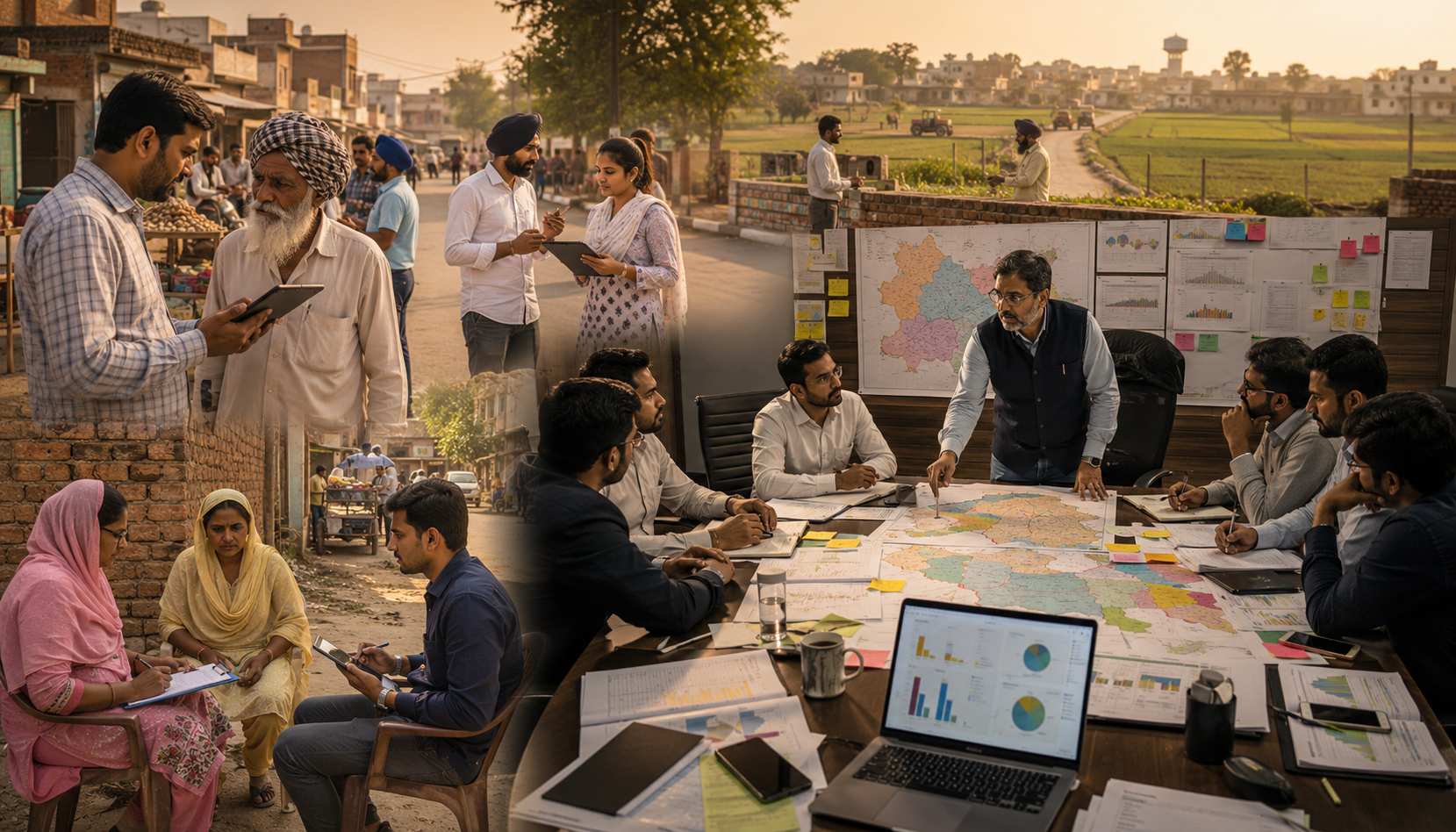
Every election in Punjab tells a story that nobody saw coming until the votes were actually counted. Go back to 2022 and you’ll remember how the Aam Aadmi Party swept the state with 92 out of 117 seats, a result that left several old-guard parties stunned and several pollsters red-faced. Fast forward to May 2026, and Punjab’s municipal elections threw up another reminder of how fast political ground shifts here, with AAP winning 958 of the 1,977 wards counted, Congress picking up around 346, and the BJP climbing from a mere 20 wards in 2021 to 163 wards this time around. Numbers like these are not just trivia for news channels. They are proof that Punjab voters change their minds quickly, and that any party or candidate who wants to win here cannot afford to guess.
This is exactly where an opinion poll survey in Punjab earns its place as one of the most important tools in a campaign. It is not a luxury reserved for national parties with deep pockets. It is the difference between a candidate who knows where they stand and one who finds out only on counting day, when it is too late to do anything about it. This article walks you through, in plain language, how opinion polls and data actually help a candidate or a party win a Punjab election, what goes into a proper survey, and how to read and use the numbers once you have them.
Why Punjab Elections Are Harder to Predict Than Most People Think
Punjab is not a state where one wave decides everything. Unlike some states where a single big personality or a single national narrative can sweep an election, Punjab voters tend to weigh local issues, local candidates, caste and community equations, and state-specific concerns like agriculture, drug abuse, unemployment, and law and order all at once. An opinion poll survey for Punjab election campaigns exists precisely because this mix of factors is too complicated to judge by gut feeling alone.
Consider how things have moved over just the last few years. In the 2024 Lok Sabha election, Congress and AAP finished almost neck to neck in vote share across the state, with Congress winning seven seats and AAP three, while the BJP, contesting all 13 seats alone for the first time without its old ally the Shiromani Akali Dal, still managed to push its vote share up to over 18 percent. Then in May 2026, the municipal election results showed AAP still dominant but Congress holding on as the clear second force, while the BJP kept growing its footprint, especially in urban pockets like Abohar.
Meanwhile, AAP convenor Arvind Kejriwal publicly suggested in June 2026 that the Punjab assembly election itself could be moved up to November 2026 instead of the originally expected February 2027 date, citing AAP’s strong civic poll performance as a reason to go to the people sooner. When the political ground is shifting this much within a matter of months, a candidate who is not tracking sentiment regularly through a proper opinion poll survey in Punjab is essentially flying blind.
What an Opinion Poll Survey in Punjab Actually Measures
A lot of people hear the term “opinion poll” and think it’s just a percentage figure that gets flashed on television a few days before voting. In reality, a well-designed opinion poll survey for Punjab election preparation measures far more than just “who will win.” It captures the mood of the constituency in layers, and each layer tells the campaign team something specific they can act on.
The first layer is straightforward vote share estimation, broken down not just at the state level but constituency by constituency, and ideally booth by booth. Punjab has 117 assembly constituencies, and each one behaves differently. A survey that only gives you a statewide number is not particularly useful to a candidate contesting a single seat in, say, Bathinda or Patiala, because local dynamics there can look nothing like the state average.
The second layer is candidate perception. This means understanding how voters actually feel about a specific candidate’s image, whether they see them as trustworthy, approachable, hardworking, or distant and unreachable. Two candidates from the same party contesting in similar constituencies can have very different personal approval ratings, and that gap often decides close contests.
The third layer is issue mapping, which identifies what is actually bothering voters in a particular area. In rural Malwa belt constituencies, agrarian distress, irrigation water, and crop pricing might dominate conversations. In urban centres like Ludhiana or Jalandhar, unemployment, drug-related concerns, and civic infrastructure tend to come up more often. A campaign that talks about the wrong issue in the wrong area, even with good intentions, wastes valuable time and money.
The fourth layer is swing voter identification. Every constituency has a chunk of voters who are genuinely undecided or only softly attached to a party. These are the voters who actually decide close elections, and a good opinion poll survey in Punjab tells you roughly how large this group is and what kind of messaging is likely to move them.
How Opinion Polls Actually Help a Candidate Win
It helps to think about this in very practical terms rather than abstract ones. Imagine two candidates contesting neighbouring seats in Punjab. One of them commissions a proper opinion poll survey three months before the election. The other relies on what party workers tell them in casual conversation, what they read in local newspapers, and what feels right based on past experience.
The candidate with survey data knows, going in, which booths are already strongly in their favour and do not need much campaign energy spent on them. They know which booths are genuinely competitive and deserve the bulk of their door-to-door effort, rally visits, and local outreach. They know which booths are essentially lost causes for now, and whether it is worth investing resources trying to flip them or better to focus elsewhere. This kind of targeting is something that cannot be done well without data, because human intuition about “which areas like us” is notoriously unreliable, especially in a state as diverse as Punjab.
The candidate also knows, from the perception scores in their opinion poll survey for Punjab election research, exactly what is hurting their image and what is helping it. If voters see them as inaccessible, the campaign can deliberately schedule more community meetings and door visits to fix that specific perception. If voters trust their integrity but doubt their ability to get things done, the messaging can shift to highlighting concrete past work and specific promises rather than vague slogans.
Finally, because the survey identifies the issues that matter most in each segment of the constituency, the candidate’s speeches, pamphlets, and social media content can be tailored to address exactly what voters in that area care about, instead of running one generic message across the whole seat. This kind of precision is what separates a campaign that wins close contests from one that loses them by a small margin while wondering what went wrong.
Reading Punjab’s Recent Numbers the Right Way
It is worth slowing down here and looking at what the 2026 municipal poll numbers actually tell us, because they offer a live case study in how data should be interpreted, not just reported. AAP’s win of 958 wards out of 1,977 counted gives them a clear lead, but it is not an overwhelming majority of the total, which means there is still a large pool of wards where other parties or independents performed competitively.
Congress holding onto roughly 346 wards confirms it remains the principal opposition force on the ground, even though it has struggled at the state assembly and Lok Sabha level in recent years.
The BJP’s jump from just 20 wards in the 2021 cycle to 163 wards in 2026 is the kind of trend line that any serious opinion poll survey in Punjab should be tracking closely, because an eightfold increase, even from a low base, signals a party building organisational depth in urban Punjab that did not exist a few years ago.
None of these figures, on their own, tell a campaign manager exactly what to do. What they do is set a baseline. A serious opinion poll survey for Punjab election preparation would take a baseline like this and then dig deeper within specific constituencies to find out whether the BJP’s urban gains are concentrated in particular demographic groups, whether Congress’s voter base is ageing or attracting younger first-time voters, and whether AAP’s support is holding steady because of governance satisfaction or weakening due to anti-incumbency factors that tend to build up after a few years in power. This is the kind of granular reading that raw headline numbers from news reports simply cannot give you, and it is exactly the gap that a professional, constituency-level opinion poll survey in Punjab is designed to fill.
Building a Winning Strategy Around Survey Data
Once a candidate or party has solid opinion poll data in hand, the real work of using it begins. The first step is resource allocation. Campaign funds, volunteer time, and the candidate’s personal appearances are all limited resources, and the survey results should directly guide how they get distributed across the constituency. Booths showing strong but soft support need reinforcement to convert sympathy into actual votes. Genuinely contested booths need the heaviest investment of time and money because that is where the election will actually be decided. Booths that are clearly lost for now might still get a baseline presence, but heavy resources poured there are usually wasted.
The second step is message calibration. Data on issue priorities should directly shape what the candidate talks about in each part of the constituency. A speech in a rural belt struggling with irrigation problems should sound very different from a speech delivered in an urban ward worried about job creation, even if both are technically part of the same assembly seat.
The third step is tracking change over time.
A single opinion poll survey for Punjab election planning gives you a snapshot, but elections are won and lost over months, and sentiment can shift quickly, as Punjab’s recent political history keeps proving. Running tracking polls at regular intervals, whether monthly or more frequently as polling day approaches, lets a campaign see whether their strategy is actually working or whether they need to course-correct before it is too late. If a tracking poll shows that a particular message is not landing, or that a rival candidate’s perception scores are improving faster than expected, the campaign still has time to respond instead of finding out only when results are declared.
The fourth step is honest internal accountability. Good survey data sometimes delivers uncomfortable news, showing a candidate trailing in a seat they assumed was safe, or revealing that their own party workers are not as well-regarded on the ground as they believed. The campaigns that win are usually the ones willing to accept this kind of uncomfortable data and act on it quickly, rather than dismissing it because it does not match what they wanted to hear.
Why Accuracy and Methodology Matter More Than Speed
There is a temptation in any campaign to want fast numbers, and there is no shortage of low-cost survey operators willing to deliver a quick percentage figure within days. The problem is that an inaccurate opinion poll survey in Punjab is often worse than having no survey at all, because it gives a false sense of confidence that leads to misallocated resources and complacency in seats that actually needed urgent attention.
Accuracy in political polling comes down to a few non-negotiable basics. The sample needs to genuinely reflect the constituency’s real demographic mix across age, gender, caste, religion, occupation, and urban-rural balance, rather than being convenient to collect but skewed toward one group. Field interviews need trained investigators who can build enough trust with respondents to get honest answers rather than answers people think the surveyor wants to hear. And the data needs to go through proper verification, including back-checks on a sample of completed interviews and consistency checks to catch fabricated or low-quality fieldwork before it ever reaches the campaign’s strategy table.
For a standard Punjab assembly constituency, this typically means a sample size in the range of 800 to 1,200 respondents distributed proportionally across booths, with larger samples recommended for seats that are unusually competitive or have a complicated social mix.
Combining Field Surveys With Digital and Phone-Based Tracking
The most reliable opinion poll survey for Punjab election work today rarely relies on just one method. Face-to-face household interviews remain the gold standard because trained investigators can pick up on hesitation, body language, and contextual cues that no phone call or online form can capture, and this matters enormously in a state where political opinions are sometimes shared cautiously within families or communities. At the same time, mobile-based surveys and digital surveys play a valuable supporting role, particularly for rapid sentiment checks closer to polling day or for covering larger geographic areas quickly between full field rounds.
The smartest campaigns treat these methods as complementary rather than competing. A deep field survey early in the campaign cycle establishes the detailed baseline, including booth-level and demographic breakdowns. Lighter phone or digital tracking polls run every few weeks after that to monitor whether sentiment is holding steady or shifting, without the time and cost of running a full field survey every single time. This combination gives a campaign both depth and speed, which is exactly what is needed in a state where the political mood, as 2026’s municipal results and Kejriwal’s own comments about an advanced election timeline show, can move faster than expected.
Common Mistakes Candidates Make When Using Survey Data
Even when a campaign has good opinion poll data in front of them, it is surprisingly common to see that data misused or ignored. One frequent mistake is treating a single survey result as a permanent truth rather than a snapshot in time, and failing to commission follow-up tracking polls as the campaign progresses. Voter sentiment in Punjab has shown it can move within months, so a survey conducted six months before voting day, without any follow-up, can become outdated well before polling actually happens.
Another common mistake is cherry-picking only the parts of the data that confirm what the candidate already believed, while quietly ignoring inconvenient findings. If a survey shows weak perception scores in a particular community or ward, the right response is to investigate why and adjust the approach there, not to dismiss the finding as a sampling error because it feels uncomfortable.
A third mistake is confusing a statewide trend with what is happening in a specific constituency. Just because AAP performed strongly in the 2026 municipal elections overall does not automatically mean every individual AAP candidate in every single ward or constituency is equally secure. Local factors, local candidate quality, and local issues can produce results that look very different from the broader state pattern, which is exactly why constituency-specific opinion poll survey in Punjab work matters more than relying on generalised state-level estimates.
Why Local Expertise Cannot Be Replaced by Guesswork or Outsiders
Punjab’s political and social fabric has layers that are genuinely difficult for outsiders to read correctly without deep local knowledge. Caste dynamics, regional identities across the Malwa, Doaba, and Majha belts, the lingering influence of religious and community institutions, and language nuances all affect how honestly a voter will answer a survey question and how that answer should be interpreted.
A field team that understands these layers, speaks the local language naturally, and is sensitive to community context will consistently get more honest and useful responses than a generic national survey operation parachuted in for a few weeks.
This is also why an opinion poll survey for Punjab election work benefits enormously from being conducted by Leadtech India with genuine, sustained experience in the state rather than as a one-off side project. Trust between the field investigator and the respondent is built through familiarity, and familiarity comes from knowing the ground, not just having a clipboard and a questionnaire.
Final Thoughts
Punjab does not reward campaigns that rely on assumptions, momentum from the last election, or what feels true based on conversations with a few dozen supporters. The state’s voters have repeatedly shown they will reward governance and shift loyalty quickly when they are unhappy, and the gap between a winning campaign and a losing one increasingly comes down to who actually understood the ground reality before it was too late to act on it.
An accurate, professionally conducted opinion poll survey in Punjab does not guarantee victory by itself, but it removes the single biggest risk every candidate faces, which is making important decisions based on a wrong assumption about what voters actually want. Combined with disciplined resource allocation, honest internal review of the numbers, and a willingness to adjust strategy as fresh data comes in, opinion polls become one of the most reliable tools any serious candidate or party has for actually winning a Punjab election.
Frequently Asked Questions
1. What is an opinion poll survey in Punjab and why do candidates need one?
An opinion poll survey in Punjab is a structured, scientifically designed exercise where trained researchers collect data on voter preferences, candidate image, and local issue priorities across a constituency. Candidates need this because Punjab’s electorate shifts quickly between elections, and decisions based on assumption rather than data routinely backfire, as seen in past assembly and municipal results.
2. How can an opinion poll survey for Punjab election campaigns actually help someone win?
It helps by showing exactly where a candidate is strong, where they are weak, and which voters are still undecided. This allows a campaign to direct its limited time, money, and manpower toward the booths and issues that will genuinely move the result, instead of spreading effort evenly across areas that may already be decided one way or another.
3. What is the right way to use survey data to win an election in Punjab?
The right approach is to use the data for resource allocation, message calibration, and tracking change over time. This means focusing effort on genuinely contested booths, tailoring campaign messages to match the issues each area actually cares about, and running follow-up tracking polls to see if the strategy is working as the campaign progresses.
4. How accurate are opinion poll surveys in Punjab, and what makes one reliable?
Accuracy depends on the sampling method, the quality of field interviews, and the verification process used afterward. A reliable opinion poll survey in Punjab uses a demographically representative sample, trained local field investigators, and back-checks to catch errors or fabricated data, typically with 800 to 1,200 respondents per assembly constituency for dependable results.
5. How is the political situation in Punjab shaping up for the next assembly election?
As of mid-2026, AAP remains the dominant force after winning 958 of 1,977 wards in the May 2026 municipal elections, Congress holds a clear second position with around 346 wards, and the BJP has grown sharply from 20 wards in 2021 to 163 wards in 2026. AAP convenor Arvind Kejriwal has also suggested the Punjab assembly election could be advanced to November 2026 from the earlier expected February 2027 timeline, which makes regular opinion poll survey for Punjab election tracking even more important for any party preparing its strategy.