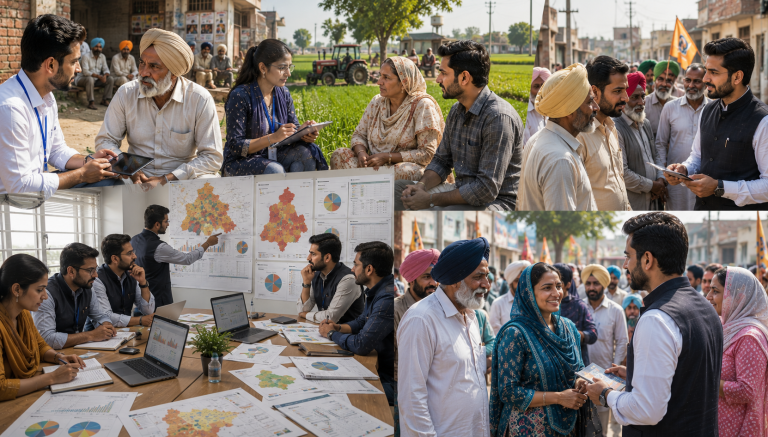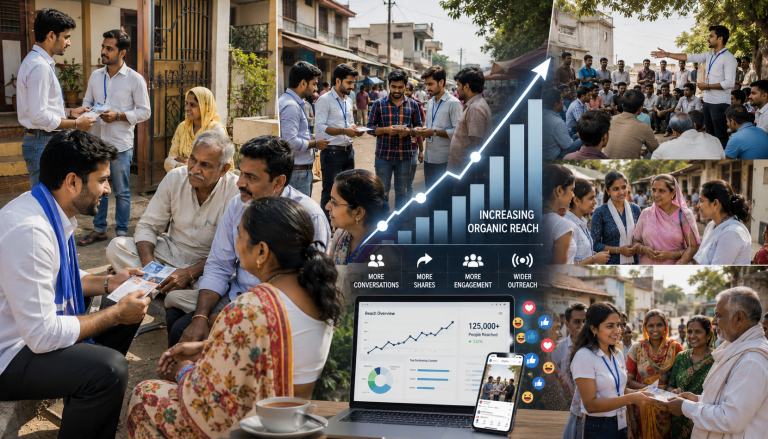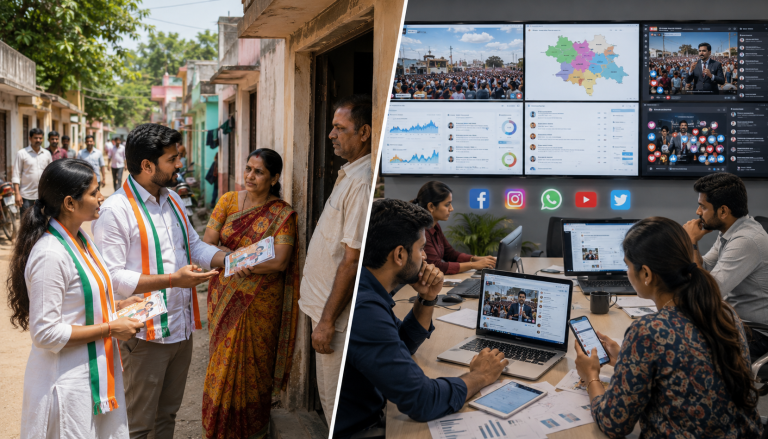

Most candidates in India know they need to be online. Fewer know what to do once they get there. Political campaigns social media management is not just posting a rally photo and hoping for likes. It’s a daily job with a lot of moving parts. Accounts need fresh content. Comments need replies. Paid boosts need budgets and targeting. And someone has to read the numbers, because voters will tell you fast if something isn’t landing. We run this work for political clients, so what follows comes from that desk. Some of it is obvious. A fair bit isn’t.
Why political campaigns social media management pays off
Voters spend their evenings on their phones. That’s the simple reason. A pamphlet gets a glance on the way to the bin. A post gets a few seconds, and if it’s good, it gets shared to people the candidate has never met. Reach is the easy part to sell. The hard part is keeping it up. Plenty of accounts go quiet after the first month, and a dead account says more than any slogan. So plan for the boring weeks too.
I’ll admit I find the phrase “digital first” irritating. It makes the work sound like grand strategy. Mostly it’s showing up every morning with something worth reading.
Where the voters are online
Facebook alone had 706.9 million users in India in June 2026, according to NapoleonCat, which compiles estimates from Meta’s advertising data. That’s the addressable audience, not a count of voters, and the monthly estimates move around. Still, it’s a big room. People aged 25 to 34 are the largest group, at 37.8 percent of users. Men make up 69.7 percent. So plan your content for that imbalance, then ask whether the women and older voters you need are actually seeing it.
Platform by platform: where each one earns its keep
Platforms don’t all do the same job. Cross-posting the same text everywhere is lazy, and voters can tell. Each one wants a different length and tone.
Facebook and Instagram
Facebook and Instagram run on the same ad system, which makes budgets easier to split. I’d pick one as the main channel and use the other for photos and short clips. Choose the platform your candidate will actually keep up with, not the one with the biggest audience on paper.
YouTube
YouTube pays off slower, but people will sit through a full speech there. Upload the whole thing, then cut three or four clips for the other platforms. That one habit saves more time than any tool I’ve tried.
X
X moves fast and punishes slow replies. If your candidate can’t answer a sharp question within the hour, the thread has moved on. Keep one person on it during the day. And please, don’t let anyone argue with strangers at midnight.
WhatsApp runs on groups, not feeds. My guess is that a forward from a relative beats a candidate’s post every time, which is annoying but worth planning around. Bulk messaging needs the most care. Under the Election Commission’s 2026 order, bulk SMS and voice messages count as political advertising, so they need pre-certification before they go out.
Pre-certification: the rule every campaign must check
This is the part most teams skip, and in India you can’t skip it. On March 20, 2026, the Election Commission of India (ECI) ordered parties and candidates to get political advertisements pre-certified by the Media Certification and Monitoring Committee, or MCMC, before release. The rule covers television, radio, e-papers, bulk SMS and internet platforms, including social media. No political ad goes online without that approval.
The order covered the assembly polls in Assam, Kerala, Tamil Nadu, West Bengal and Puducherry, plus bye-elections. An earlier order from October 2025 applied the same rule to the Bihar elections. So check the order that covers your election, because these directions are issued for specific polls.
The process is practical. Candidates apply to the District MCMC. Parties headquartered in a state apply to the State-level MCMC. Candidates also list their authentic social media accounts in their nomination affidavit, so the accounts you run should match what you declared.
Then there’s the money. Parties must submit a statement of internet campaign spending within 75 days of the elections ending. That covers payments to internet companies and websites for ads, plus content creation and the cost of running accounts. Keep invoices from day one. Rebuilding spending records in month three is misery.
This is a summary of the ECI’s public notices, not legal advice. Have your legal team check the current order before you act.
Where an election campaign management system fits
Political campaigns social media management tends to fall apart in spreadsheets. One person has the passwords, another has the content calendar, and a third answers messages from their phone at dinner. An election campaign management system puts all of that in one place. Look for role-based logins, a shared approval queue, and an audit trail. The approval queue matters more now. Every ad needs MCMC clearance, so a draft sitting on someone’s phone is a risk. Your system should show which ads are cleared and which aren’t.
Permissions deserve a minute of thought. Give volunteers access to drafts, not the publish button. Revoke logins the day someone leaves, and don’t wait for a reminder. People forget about accounts for months after they’ve quit.
A political campaign management system is wider than social media. It often also covers volunteers, voter data and field tasks. If you only need posting and replies, a full system may be more than you need. I’d start with the social tools, then add the rest once the team has outgrown them. Buying a platform nobody opens is an expensive mistake.
Political campaigns social media management: in-house or outsourced?
Most small campaigns can’t afford a full team, so the real question is whether to hire or outsource. An in-house person knows the candidate well and can react in minutes. An agency brings people who’ve run several campaigns and can cover nights and weekends. Neither wins outright. The mistake I see most often is hiring one junior person and expecting them to handle political campaigns social media management alone for six months. That’s a lot of pressure on one phone.
Write down who approves what before launch, because the group chat is a bad place to decide it. Then argue about tone in a meeting, not at midnight.
What to measure, and what to ignore
Likes feel good and tell you almost nothing. Track the actions that matter, like a volunteer sign-up or a click on a donation link. Watch the share rate on clips, because a clip that gets passed around is worth more than a post that gets a thumbs-up. Ignore follower counts from the week of a big news event. They spike and fall back, and they say little about who will actually vote.
Check the comments weekly for patterns, not just the loudest voices. The angry person at the top of the thread is rarely the one who decides anything.